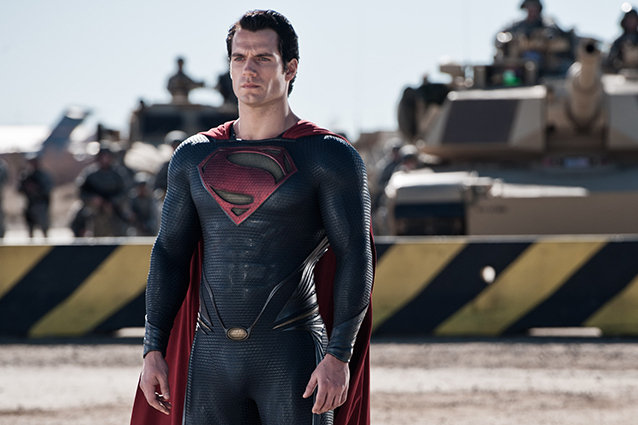
Warner Bros.
Somewhere along the timeline of his formative years, Kansas-raised
Clark Kent comes to the realization that he can take a punch like
nobody's business. He determines on one fateful afternoon that he has
the ability — and as his internal makeup commands, the duty — to save a
sinking school bus filled with his horrified classmates after it careens
off a delicate bridge into one of the Sunflower State's many proud
bodies of water. It is this journey, told exclusively through
flashbacks, that comprises the very best of Man of Steel.A young Clark has no understanding of himself, his origins, his powers, or his place in the world. And the boy's soft-spoken, earnest adoptive father Jonathan has nothing but compassion to offer his struggling son. He muddles pieces of conflicting advice, telling Clark simultaneously that he needs to hide his abilities in order to safeguard himself from the intolerant planet Earth, all the while prophesying the day when the Krypton-born navel gazer will have to decide, once and for all, what sort of man he wants to be. But no amount of the senior Kent's empathy and wisdom can foster our young hero through his turmoil. "Man," we think during the movie's earliest childhood scenes. "All this groundwork is going to pay off big time when he finally gets that suit."
But like the preteen Clark, Zack Snyder's Man of Steel has an identity crisis. While an early adulthood Superman should still be struggling with the issues presented in his extensive maudlin memories, the second half of the movie seems to suppress these ideas. Instead of the probing "Who am I?” and "Who am I supposed to be?" questions that make Superman (despite scathing criticisms) a genuinely interesting character, the film opts for a warfare between Clark and Zod that represents the war between Earth and Krypton — both for claim to the planet and for claim to Clark's psyche.
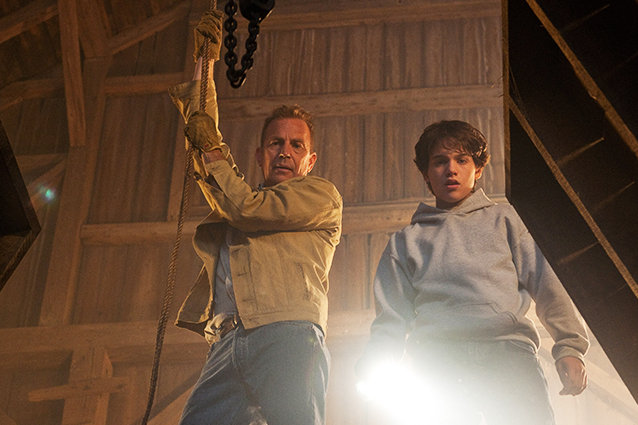
Warner Bros.
Of course, the themes interweave. Zod invades Earth in hopes of
retrieving the grown Kal-El (who holds the genetic code for a populace
of unborn Kryptonians) and using the planet as a new breeding ground for
his people. As such, the decision is posed to Clark: live among the
Earthlings, a race from which you've been forced to hide your true
identity, or among your own kind. It seems like it should translate
effectively to the sort of gripping questions introduced vaguely by the
powerful boyhood material. But the whole ordeal — which plays out with
an hour long mêlée between Superman (that's what they're calling him, so
says a humble military man) and Zod through the war-torn streets of
Metropolis — feels far less personal than what was promised.Man of Steel sets itself up as close to the heart of the Kryptonian immigrant as possible. While the legacy undertaken from birth father Jor-El is vast and imbued with intergalactic consequence, what separates Man of Steel (or what is meant to) is the earthbound backstory. But the conflict planted by a sobbing Jonathan Kent, played tear-inspiringly by Kevin Costner, calls for more than it eventually pays off to be.
The Clark Kent we see in the vivid, hard-to-choke-down flashback scenes deserves more than the us-or-them breathless battle that the film's third act takes. This chapter isn't without its appeals: the action is unprecedented. The acting — that of Michael Shannon and Russell Crowe's Prometheus-like ghost — is nothing to sneeze at. In fact, the conclusive arc's biggest enemy is how good the early parts of the movie are. With so much to live up to, so much to deliver, Superman's face-off with General Zod seems to fall in the territory of the DC character's older, less substantial material. Thus, the film on the whole — even its near perfect days in somber small town Kansas — suffers. While Man of Steel does tinker with the idea that Superman's greatest enemy is himself, I don't think this is how they meant that.
As far as an effort to reconstruct Superman might go, Man of Steel is a noble one. If anything, Zack Snyder tried to inject too much into his project: the vast array of identity issues that Clark might face, a melding of DC past with the sophistication of the present pop culture psyche, and — of course — the sort of action that you can't avoid in a superhero flick like this. Each, individually, is a success. But together, the components start stepping all over one another, leaving little room for the sort of expansion that the most valuable facets deserve. As a result, Man of Steel isn't fun enough or deep enough to satisfy either end of the superhero movie spectrum. It's got a little of both, but not enough of either. Some might call it the nature of the beast. But sweeping accusations aside, Superman can be an interesting character. We just have to decide what it is that is interesting about him.
2.5/5

No comments:
Post a Comment